
.
Mein Kampf: The Secrets of Adolf Hitler's Book of Evil > .Mein Kampf: Exposing Horrifying Secrets Inside Hitler's Banned Book - Diary > .
Dark Mysteries Of Hitler's Nazi Manifesto | Mein Kampf | HiHi > .
Hitler’s Mein Kampf was first published in 1925. The 700-page work has been translated into 18 languages, sold over 12 million copies and been revised numerous times since Hitler's death. Almost everyone knows of it, yet hardly anyone has actually read it. Mein Kampf is a book of paradoxes, famous yet unfamiliar - fascinating and repellant at the same time.
The same election inspired Blanche Dugdale to urge her husband, E. T. S. Dugdale, to write an abridgement of Mein Kampf. Dugdale began his work on this abridgement in about 1931, but he, too, was unable to find a publisher for it. In early 1933, at the time of the Nazi seizure of power in Germany, Dugdale apparently got in touch with Eher Verlag, who put him into contact with Kearton, now working for the firm of Hurst and Blackett. The latter firm was in the process of buying the translation rights from Curtis Brown for a sum of £350. Dugdale offered the abridgment to Hurst & Blackett free of charge, with the stipulation that his name not be used for the British edition. Before the book could go to press, however, Hurst and Blackett were visited by Dr. Hans Wilhelm Thost, London correspondent of the Völkischer Beobachter and an active member of the "Nazi organization" in London. Despite Eher Verlag's being satisfied with Dugdale's abridgement, Thost insisted on taking a copy to Berlin for further censoring and official sanction. The abridgement was finally published in October 1933. Titled My Struggle the book was published as the second number in the Paternoster Library.
In the United States, Houghton Mifflin secured the rights to the Dugdale abridgement on July 29, 1933. The only differences between the American and British versions are that the title was translated My Struggle in the UK and My Battle in America; and that Dugdale is credited as translator in the US edition, while the British version withheld his name. The original price was $3.00.
In January 1937, Houghton Mifflin issued a second edition, the first having sold out. The price was lowered to $2.50. The publishers replaced the old dust jacket that featured Hitler giving his salute over a black and white background with a new one that featured panels of black, red, and yellow and a quote from Dorothy Thompson. This led to an official protest by the German government, as the black-red-yellow color scheme was emblematic of the liberal German revolutions of 1848–49 and the Weimar Republic, while the Nazis had returned to the black, white, red of the Second Reich. Thomson's quote was also objected to, as she was expelled from the Reich in 1934 after writing unflattering accounts of Hitler. The affair lasted into March 1937, with Houghton Mifflin agreeing to change the yellow to white, though it is unknown if the Dorothy Thompson quote was ever removed.
There were three separate [US] printings from August 1938 to March 1939, totaling 14,000; sales totals by March 31, 1939 were 10,345.
https://time.com/4161722/mein-kampf-hitler-germany/ .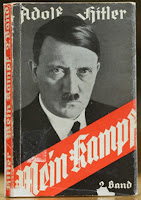
.....
The Dugdale abridgement was published in October 1933. Titled My Struggle the book was published as the second number in the Paternoster Library.
Excerpts from Mein Kampf in The Lion Has Wings > .
Excerpts from Mein Kampf in The Lion Has Wings > .
Mein Kampf (My Struggle or My Fight) is a 1925 autobiographical manifesto by Nazi Party leader Adolf Hitler.
....
Hitler originally wanted to call his forthcoming book Viereinhalb Jahre (des Kampfes) gegen Lüge, Dummheit und Feigheit, or Four and a Half Years (of Struggle) Against Lies, Stupidity and Cowardice. Max Amann, head of the Franz Eher Verlag and Hitler's publisher, is said to have suggested the much shorter "Mein Kampf" or "My Struggle"....
The work describes the process by which Hitler became antisemitic and outlines his political ideology and future plans for Germany. Volume 1 of Mein Kampf was published in 1925 and Volume 2 in 1926. The book was edited firstly by Emil Maurice, then by Hitler's deputy Rudolf Hess.
....
Hitler originally wanted to call his forthcoming book Viereinhalb Jahre (des Kampfes) gegen Lüge, Dummheit und Feigheit, or Four and a Half Years (of Struggle) Against Lies, Stupidity and Cowardice. Max Amann, head of the Franz Eher Verlag and Hitler's publisher, is said to have suggested the much shorter "Mein Kampf" or "My Struggle"....
The work describes the process by which Hitler became antisemitic and outlines his political ideology and future plans for Germany. Volume 1 of Mein Kampf was published in 1925 and Volume 2 in 1926. The book was edited firstly by Emil Maurice, then by Hitler's deputy Rudolf Hess.
....
Hitler began Mein Kampf while imprisoned for what he considered to be "political crimes" following his failed Putsch in Munich in November 1923. Although Hitler received many visitors initially, he soon devoted himself entirely to the book. As he continued, Hitler realized that it would have to be a two-volume work, with the first volume scheduled for release in early 1925. The governor of Landsberg noted at the time that "he [Hitler] hopes the book will run into many editions, thus enabling him to fulfill his financial obligations and to defray the expenses incurred at the time of his trial." After slow initial sales, the book was a bestseller in Germany after Hitler's rise to power in 1933.
Hitler began Mein Kampf while imprisoned for what he considered to be "political crimes" following his failed Putsch in Munich in November 1923. Although Hitler received many visitors initially, he soon devoted himself entirely to the book. As he continued, Hitler realized that it would have to be a two-volume work, with the first volume scheduled for release in early 1925. The governor of Landsberg noted at the time that "he [Hitler] hopes the book will run into many editions, thus enabling him to fulfill his financial obligations and to defray the expenses incurred at the time of his trial." After slow initial sales, the book was a bestseller in Germany after Hitler's rise to power in 1933.
After Hitler's death, copyright of Mein Kampf passed to the state government of Bavaria, which refused to allow any copying or printing of the book in Germany. In 2016, following the expiration of the copyright held by the Bavarian state government, Mein Kampf was republished in Germany for the first time since 1945, which prompted public debate and divided reactions from Jewish groups.
https://en.wikipedia.org/wiki/Mein_Kampf .
Ever since the early 1930s, the history of Adolf Hitler's Mein Kampf in English has been complicated and has been the occasion for controversy. No fewer than four full translations were completed before 1945, as well as a number of extracts in newspapers, pamphlets, government documents and unpublished typescripts. Not all of these had official approval from his publishers, Eher Verlag. Since the war, the 1943 Ralph Manheim translation has been the most popular published translation, though other versions have continued to circulate.
Ever since the early 1930s, the history of Adolf Hitler's Mein Kampf in English has been complicated and has been the occasion for controversy. No fewer than four full translations were completed before 1945, as well as a number of extracts in newspapers, pamphlets, government documents and unpublished typescripts. Not all of these had official approval from his publishers, Eher Verlag. Since the war, the 1943 Ralph Manheim translation has been the most popular published translation, though other versions have continued to circulate.
...
Eher Verlag took steps to secure the copyright and trademark rights to Mein Kampf in the United States in 1925 and 1927. In 1928 the literary agency Curtis Brown, Limited secured the assignment for negotiation of translation rights in the United States and Great Britain, and a German copy was picked up by their employee, Cherry Kearton. However, the firm found it difficult to interest publishers in the 782-page book by the leader of what was then an obscure splinter party in Germany. Even after the elections of September 1930, when the Nazi Party became the second largest party in the Reichstag, publishers were cautious about investing in a translation, due to the Great Depression.
The same election inspired Blanche Dugdale to urge her husband, E. T. S. Dugdale, to write an abridgement of Mein Kampf. Dugdale began his work on this abridgement in about 1931, but he, too, was unable to find a publisher for it. In early 1933, at the time of the Nazi seizure of power in Germany, Dugdale apparently got in touch with Eher Verlag, who put him into contact with Kearton, now working for the firm of Hurst and Blackett. The latter firm was in the process of buying the translation rights from Curtis Brown for a sum of £350. Dugdale offered the abridgment to Hurst & Blackett free of charge, with the stipulation that his name not be used for the British edition. Before the book could go to press, however, Hurst and Blackett were visited by Dr. Hans Wilhelm Thost, London correspondent of the Völkischer Beobachter and an active member of the "Nazi organization" in London. Despite Eher Verlag's being satisfied with Dugdale's abridgement, Thost insisted on taking a copy to Berlin for further censoring and official sanction. The abridgement was finally published in October 1933. Titled My Struggle the book was published as the second number in the Paternoster Library.
In the United States, Houghton Mifflin secured the rights to the Dugdale abridgement on July 29, 1933. The only differences between the American and British versions are that the title was translated My Struggle in the UK and My Battle in America; and that Dugdale is credited as translator in the US edition, while the British version withheld his name. The original price was $3.00.
In January 1937, Houghton Mifflin issued a second edition, the first having sold out. The price was lowered to $2.50. The publishers replaced the old dust jacket that featured Hitler giving his salute over a black and white background with a new one that featured panels of black, red, and yellow and a quote from Dorothy Thompson. This led to an official protest by the German government, as the black-red-yellow color scheme was emblematic of the liberal German revolutions of 1848–49 and the Weimar Republic, while the Nazis had returned to the black, white, red of the Second Reich. Thomson's quote was also objected to, as she was expelled from the Reich in 1934 after writing unflattering accounts of Hitler. The affair lasted into March 1937, with Houghton Mifflin agreeing to change the yellow to white, though it is unknown if the Dorothy Thompson quote was ever removed.
...
89,390 copies of the Dugdale abridgment were sold in the United Kingdom between 1933 and 1938.
...
The Reich Ministry of Public Enlightenment and Propaganda commissioned James Vincent Murphy, who had been employed to make English translations of Hitler's speeches and other items, to begin an English translation of Mein Kampf in late 1936 and it was finished by the fall of 1937. However, the Propaganda Ministry cancelled the project and sequestered all copies of the manuscript. Murphy was beginning to be seen as "unreliable" by the government and was dismissed from his position at the Ministry.
...
Murphy was convinced to return to Germany to secure both a copy of the manuscript and permission to publish it, but on the date he was scheduled fly to Berlin. he was denied an entry visa and told he would be wasting his time. Therefore, his wife, Mary, decided to make the trip, finally crossing the Channel on November 6, 1938. In Berlin she was unable to schedule any appointments with the Propaganda Ministry until November 10. This meant she was in Berlin during the infamous Kristallnacht pogrom of November 9. The next day she met with Heinrich Bohle at the Propaganda Ministry, but could not get anywhere. She pursued other contacts within the Ministry but came up empty handed. Finally, without any more money and living with her ex-house keeper, she decided to visit one of James' former secretaries whom he had employed as a typist. To her great relief, she still had one of the handwritten copies of the James Murphy translation. She left Berlin on November 20 ['38].
...
Murphy's translation hit the stores in the United Kingdom on March 20, 1939. ... Because so many records were destroyed during the war, accurate sales figures on Murphy's translation are difficult to establish. Robert Sommerfeld reported that approximately 32,000 copies were sold by August 1939. There was also an illustrated edition and a serial edition in eight parts. It has been conjectured that 150,000–200,000 copies were sold in total.
Other translations followed. Murphy translation, Reynal and Hitchcock translation, Stackpole translation and controversy, Manheim translation, Ford translation, Sterling translation, Dalton translation .
----
James Vincent Murphy has been accused of translating the German word "Hakenkreuz" (Hooked Cross) which Nazis called their symbol, as "Swastika", a Hindu religious symbol signifying prosperity and wellness. However, in European and Indo-European tradition the Swastika is the symbol of the cyclic nature of time and space. The Swastika has been found throughout Europe and especially in Scandinavian Bronze age inscriptions.https://time.com/4161722/mein-kampf-hitler-germany/ .


