Friday, July 26, 2019

Courier Pigeons

Rats Save Humans From Landmines | BBC Earth > .


WW2 regulations
Homing pigeon regulations

24:52 ""The possession of homing or racing pigeons is forbidden except under permit, and rules are made for the protection of such pigeons.""
http://pastdaily.com/wp-content/uploads/2015/08/News-for-August-28-1939.mp3

"Everything, it seemed was either banned, restricted or rationed. Even the raising of Homing Pigeons was banned, out of fear they would carry messages between enemy agents. Clothing and food were severely rationed, with priorities given to the Military."
http://pastdaily.com/2015/08/28/eyeing-pigeons-with-suspicion-august-28-1939/

BUT

"During World War II, the United Kingdom used about 250,000 homing pigeons. The Dickin Medal, the highest possible decoration for valor given to animals, was awarded to 32 pigeons, including the United States Army Pigeon Service's G.I. Joe and the Irish pigeon Paddy.

The UK maintained the Air Ministry Pigeon Section during World War II and for a while thereafter. A Pigeon Policy Committee made decisions about the uses of pigeons in military contexts. The head of the section, Lea Rayner, reported in 1945 that pigeons could be trained to deliver small explosives or bioweapons to precise targets. The ideas were not taken up by the committee, and in 1948 the UK military stated that pigeons were of no further use. However, the UK security service MI5 was still concerned about the use of pigeons by enemy forces. Until 1950, they arranged for 100 birds to be maintained by a civilian pigeon fancier in order to prepare countermeasures. The Swiss army disbanded its Pigeon section in 1996."

https://en.wikipedia.org/wiki/War_pigeon .
AND
http://www.arcre.com/archive/pigeons .

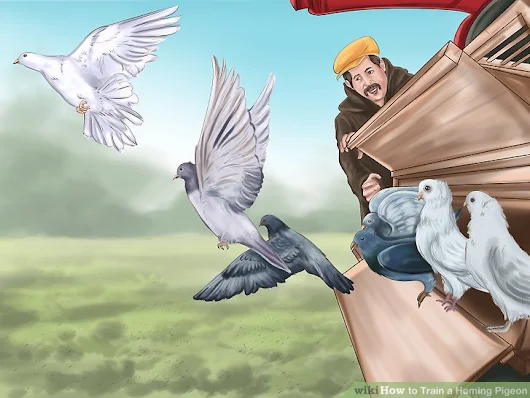
Start at 6 weeks old. Incentive to return. Increase the training distance by 5 miles per week.
https://www.wikihow.com/Train-a-Homing-Pigeon .
http://animals.mom.me/train-homing-pigeon-carry-message-10844.html .

Each pair of pigeons should have approximately 8-10 cubic feet of space inside the loft - so the space you have available for a loft might also dictate the maximum number of pigeons you can have.

Adding new pigeons to your collection -- keep them separated from your existing pigeons for a couple of weeks.

The training schedule should allow for training to occur at least once a day, and either the method or distance being worked on should change once a week. For example: everyday during week 1 practice going in and out of the trap door with the pigeon; everyday during week 2 practice returning to the loft from 1 mile away; etc.

Start by taking your pigeons 1 mile from home and releasing them. Do this several times a week.
Use a cage or a basket to carry your pigeons to the release location.

Each week go further away from home to release your pigeons, and go in different directions each time.
Don’t expand the distance too far, too fast. If your pigeons have any trouble, stop increasing the distance and continue training them at the last distance they were successful.

Create a second “home” for your pigeons. Train them to fly between two loft locations. Feed your pigeons at both lofts periodically, to give them incentive to want to return to each loft. If they’re at one loft and are hungry, they’ll fly to the other loft to look for food.
Thursday, July 25, 2019

Deep State - Technocrats Pulling Levers

2018 What is the deep state? - CaspianReport > .

1957 Defence White Paper

1957 Defence White Paper - Britain's Plans to Defend Against the Soviets - Cold War > .

Dissenters - Labour Movement

.Religion, Origins Labour Movement | Dissenters, Ethical Socialism, Labour Church > .

English Dissenters or English Separatists were Protestant Christians who separated from the Church of England in the 17th and 18th centuries.

A dissenter (from the Latin dissentire, "to disagree") is one who disagrees in opinion, belief and other matters. English Dissenters opposed state interference in religious matters, and founded their own churches, educational establishments and communities. Some emigrated to the New World, especially to the Thirteen Colonies and Canada. Brownists founded the Plymouth colony. English dissenters played a pivotal role in the spiritual development of the United States and greatly diversified the religious landscape. They originally agitated for a wide-reaching Protestant Reformation of the established Church of England, and they flourished briefly during the Protectorate under Oliver Cromwell.

King James VI of Scotland, I of England and Ireland, had said "no bishop, no king", emphasising the role of the clergy in justifying royal legitimacy. Cromwell capitalised on that phrase, abolishing both upon founding the Commonwealth of England. After the restoration of the monarchy in 1660, the episcopacy was reinstalled and the rights of the Dissenters were limited: the Act of Uniformity 1662 required Anglican ordination for all clergy, and many instead withdrew from the state church. These ministers and their followers came to be known as Nonconformists, though originally this term referred to refusal to use certain vestments and ceremonies of the Church of England, rather than separation from it.
..
In the 18th century, one group of Dissenters became known as "Rational Dissenters". In many respects they were closer to the Anglicanism of their day than other Dissenting sects; however, they believed that state religions impinged on the freedom of conscience. They were fiercely opposed to the hierarchical structure of the Established Church and the financial ties between it and the government. Like moderate Anglicans, they desired an educated ministry and an orderly church, but they based their opinions on the Bible and on reason rather than on appeals to tradition and authority. They rejected doctrines such as the original sin or Trinity, arguing that they were irrational. Rational Dissenters believed that Christianity and faith could be dissected and evaluated using the newly emerging discipline of science, and that a stronger belief in God would be the result.

Another significant dissenting tradition that emerged at the end of the 18th century is the Swedenborgian church, which continues today in several branches around the world. It originated in London in 1780. Beginning as groups reading Emanuel Swedenborg (1688–1772), whose members were composed largely of Methodists, Baptists, and Anglicans, some of the Swedenborgian enthusiasts became disillusioned with the prospects for thorough Swedenborgian theological reform within their respective traditions. These left those churches to form the General Conference of the New Jerusalem, often called simply the New Church. 

Wednesday, July 24, 2019

English Common Law


Evolution of English Law; 600 BCE+ 

The Institutes of the Lawes of England are a series of legal treatises written by Sir Edward Coke. Sir Edward Coke SL (1 February 1552 – 3 September 1634) was an English barrister, judge, and politician who is considered to be the greatest jurist of the Elizabethan and Jacobean eras. Born into an upper-class family, Coke was educated at Trinity College, Cambridge, before leaving to study at the Inner Temple, where he was called to the Bar on 20 April 1578. As a barrister he took part in several notable cases, including Slade's Case, before earning enough political favour to be elected to Parliament, where he served first as Solicitor General and then as Speaker of the House of Commons. Following a promotion to Attorney General he led the prosecution in several notable cases, including those against Robert Devereux, Sir Walter Raleigh, and the Gunpowder Plot conspirators. As a reward for his services he was first knighted and then made Chief Justice of the Common Pleas.

As Chief Justice, Coke restricted the use of the ex officio (Star Chamber) oath and, in the Case of Proclamations and Dr. Bonham's Case, declared the King to be subject to the law, and the laws of Parliament to be void if in violation of "common right and reason".[3] These actions eventually led to his transfer to the Chief Justiceship of the King's Bench, where it was felt he could do less damage. Coke then successively restricted the definition of treason and declared a royal letter illegal, leading to his dismissal from the bench on 14 November 1616. With no chance of regaining his judicial posts, he instead returned to Parliament, where he swiftly became a leading member of the opposition. During his time as a Member of Parliament he wrote and campaigned for the Statute of Monopolies, which substantially restricted the ability of the monarch to grant patents, and authored and was instrumental in the passage of the Petition of Right, a document considered one of the three crucial constitutional documents of England, along with Magna Carta and the Bill of Rights 1689.

Coke is best known in modern times for his Institutes, described by John Rutledge as "almost the foundations of our law", and his Reports, which have been called "perhaps the single most influential series of named reports". Historically, he was a highly influential judge; within England and Wales, his statements and works were used to justify the right to silence, while the Statute of Monopolies is considered to be one of the first actions in the conflict between Parliament and monarch that led to the English Civil War. In America, Coke's decision in Dr. Bonham's Case was used to justify the voiding of both the Stamp Act 1765 and writs of assistance, which led to the American War of Independence; after the establishment of the United States his decisions and writings profoundly influenced the Third and Fourth amendments to the United States Constitution while necessitating the Sixteenth.

The Institutes were first published, in stages, between 1628 and 1644. Widely recognized as a foundational document of the common law, they have been cited in over 70 cases decided by the Supreme Court of the United States, including several landmark cases. For example, in Roe v. Wade (1973), Coke's Institutes are cited as evidence that under old English common law, an abortion performed before quickening was not an indictable offence. In the much earlier case of United States v. E. C. Knight Co. (1895), Coke's Institutes are quoted at some length for their definition of monopolies. The Institutes's various reprinted editions well into the 19th century is a clear indication of the long lasting value placed on this work throughout especially the 18th century in Britain and Europe. It has also been associated through the years with high literary connections. For example, David Hume in 1764 requested it from the bookseller Andrew Millar in a cheap format for a French friend.

John Lilburne (1614 – 29 August 1657), also known as Freeborn John, was an English political Leveller before, during and after the English Civil Wars 1642–1650. He coined the term "freeborn rights", defining them as rights with which every human being is born, as opposed to rights bestowed by government or human law. In his early life he was a Puritan, though towards the end of his life he became a Quaker. His works have been cited in opinions by the United States Supreme Court.

sī vīs pācem, parā bellum

igitur quī dēsīderat pācem praeparet bellum    therefore, he who desires peace, let him prepare for war sī vīs pācem, parā bellum if you wan...